
EPA Introduces Groundbreaking Drinking Water Standards for PFAS
The Environmental Protection Agency (EPA) has taken a significant step forward in safeguarding public health by issuing the first-ever drinking water standards for per- and polyfluoroalkyl substances (PFAS). This landmark action addresses growing concerns over the widespread presence of these persistent chemicals in water sources across the United States. PFAS, often referred to as “forever chemicals,” have been linked to a range of adverse health effects, including cancer, immune system dysfunction, and developmental issues. They have garnered increased attention in recent years due to their prevalence in various consumer products and industrial processes. The EPA’s establishment of drinking water standards for PFAS marks a crucial development in the agency’s efforts to address the risks posed by these substances. By setting enforceable limits for two of the most common PFAS compounds, perfluorooctanoic acid (PFOA) and perfluorooctane sulfonate (PFOS), the EPA aims to ensure that drinking water supplies are safe and free from harmful levels of contamination. Under the new standards, water systems will be required to monitor and control levels of PFOA and PFOS, with the goal of reducing exposure and protecting public health. This regulatory action provides clarity and accountability for water utilities, as well as reassurance for consumers concerned about the quality of their drinking water. The EPA’s decision to establish these standards follows years of scientific research and public advocacy highlighting the potential risks associated with PFAS exposure. It reflects a commitment to evidence-based policymaking and proactive measures to mitigate known health hazards. However, while the introduction of drinking water standards for PFAS represents a significant milestone, it is important to recognize that challenges remain. Numerous other PFAS compounds exist, each with its own potential health implications, and further research is needed to fully understand their effects and establish appropriate regulatory measures. Additionally, addressing PFAS contamination requires a comprehensive approach that encompasses not only drinking water but also other sources of exposure, such as food, air, and consumer products. Continued collaboration between government agencies, industry stakeholders, and the scientific community will be essential to effectively manage and mitigate the risks posed by these pervasive chemicals. The EPA’s issuance of drinking water standards for PFAS marks a critical step forward in protecting public health and ensuring the safety of drinking water supplies. It represents a victory for evidence-based policymaking and underscores the importance of proactive measures to address emerging environmental challenges. However, sustained efforts will be necessary to address remaining gaps in knowledge, expand regulatory oversight, and safeguard communities from the risks associated with PFAS contamination. FAQs: 1.What prompted the EPA to issue drinking water standards for PFAS? The EPA issued drinking water standards for PFAS due to growing concerns about the health risks associated with these chemicals, which are commonly found in water sources across the United States
Unveiling EPA’s Breakthrough in Combatting PFAS Contamination in HDPE Containers
Per- and polyfluoroalkyl substances (PFAS) have long been valued across industries for their exceptional resistance to heat, water, and oil. Yet, concerns about the potential health and environmental risks associated with PFAS exposure, especially in high-density polyethylene (HDPE) containers utilized for storing various chemicals like pesticides, have been escalating. In September 2020, the U.S. Environmental Protection Agency (EPA) made a troubling discovery: several mosquito control products were contaminated with PFAS. Subsequent investigations linked the contamination to fluorinated HDPE containers, raising serious questions about the broader implications for products stored in similar vessels. Fast forward to February 15, 2024, when the EPA introduced a groundbreaking methodology capable of detecting 32 distinct PFAS compounds in HDPE containers, even at minute concentrations as low as 0.002 parts per billion (2 parts per trillion). This announcement marked a significant milestone, providing industries reliant on HDPE containers with a crucial tool to proactively screen for PFAS contamination and protect their products. The impact of this new PFAS detection method is profound: In the ongoing fight against PFAS contamination, the EPA’s latest detection methodology is a game-changer. By providing industries with a reliable means to identify and mitigate PFAS risks proactively, the EPA reaffirms its dedication to protecting public health and the environment from the dangers of PFAS exposure. For companies navigating the intricate landscape of PFAS regulations, ComplianceXL offers a team of experienced experts ready to provide guidance and support. Contact our specialists today for unparalleled assistance. FAQs: What are PFAS, and why are they a concern? PFAS (per- and polyfluoroalkyl substances) are synthetic chemicals prized for their resistance to heat, water, and oil. However, their potential health and environmental risks have sparked widespread apprehension regarding their pervasive use and contamination. How does PFAS contamination occur in HDPE containers? PFAS contamination in HDPE containers typically arises during the fluorination process employed in their manufacturing. Byproducts of this process may leach into stored products, resulting in contamination.
EPA Finalizes New Use Rule (SNUR) for 329 PFAS under TSCA
U.S. Environmental Protection Agency (EPA) recently announced a Significant New Use Rule (SNUR) to prevent 329 PFAS that are not currently in use, from re-entering the marketplace and environment. The Final Rule covers 329 per- and poly-fluoroalkyl substances so-called “forever chemicals” that are targeted as “inactive” on the TSCA Inventory, and which are not part of the existing Significant New Use Rule (SNUR). This final rule will come into effect on March 11, 2024. A SNUR normally covers details about the activities involving the chemical which the EPA considers as significant new uses. When a chemical substance is included in a TSCA Significant New Use Rule (SNUR), any person who wants to produce, process, or import that chemical for a “significant new use” must notify EPA 90 days in advance. This means that anyone who wishes to manufacture/import/process one of the 300+ covered inactive PFAS inventories will be required to notify EPA 90 days before starting the activity. Once receives a notification, EPA must review and assess whether the new use may cause an unreasonable risk to health and the environment. EPA proactively prevents PFAS from entering the air, land, and water at levels that can adversely impact human health and the environment. This SNUR is necessary to make sure that EPA receives timely advance notice of any future manufacturing (including import) or processing of inactive PFAS for new uses that may produce changes in human or environmental exposures. This Final Rule strengthens the regulation of PFAS by preventing anyone from resuming manufacturing or processing inactive PFAS without EPA review. Compliance XL provides consulting services to companies in the field of TSCA, PFAS compliance, and the collection of supplier declarations. We also help customers regularly maintain their supplier certificates and declarations to ensure they are up to date as part of their compliance and data management strategy. FAQs 1.Which chemical substances are subjected to EPA SNUR under TSCA? 329 PFAS that are currently designated as inactive on the TSCA Inventory and that are not subject to an existing SNUR. 2.What are the exemptions that applies to inactive PFAS? Inactive PFAS present as impurities, byproducts not used for commercial purposes, R&D purposes, test marketing purposes, as non-isolated intermediates and solely for export from US.
New PFAS Regulations and How to Stay Compliant
Polyfluoroalkyl substances (PFAS) are collectively known as poly-fluoroalkyl substances. Unlike natural substances, these chemicals are created by humans. Consumer products and industrial products have been containing PFAS substances for decades. Due to their toxicity to humans, animals, and the environment, the substances have come under increasing scrutiny since the early 2000s. To reduce exposure to PFAS, a variety of laws, policies, and regulations have been implemented in the United States and Europe. Maine legislature banned perfluoroalkyl and poly-fluoroalkyl substances in July 2021. As a result, PFAS was defined broader than those substances listed under the Toxic Substances Control Act (TSCA) of the United States Environmental Protection Agency (EPA). CompTox, the EPA’s list of more than 12,000 PFAS, is instead referred to in the proposed law. Manufacturers, distributors, and importers of these products in Maine must comply with the law unless an exemption has been granted. In addition to the new law, two provisions go into effect on January 1st, 2023. The following are some of them: To comply with federal regulations, manufacturers must report the amount of PFAS in their products. Despite the development of a database by the Department of Environmental Protection (DEP), reporting remains a necessity. The sale of carpets, rugs, and fabric treatments containing PFAS is prohibited. We do not include carpets or rugs that have been used. California Bill AB 1817 prohibits the sale, distribution, or offering for sale of food packaging containing PFAS chemicals. As of January 1st, 2023. The sale and distribution of new products containing PFAS chemicals will be prohibited by July 1, 2023. Toxic Substances Control Act (TSCA) Section 8(a)(7) is expected to be finalized by the Environmental Protection Agency in 2023. Since 2011, manufacturers and importers have been required to report on how PFAS are used in their products, production volumes, disposal, exposures, and hazards. Over 1,300 PFAS could potentially be covered by this rule, according to the EPA. By January 2023, five European Union states are expected to submit a proposal restricting all PFAS substances. Additionally, certain perfluoroalkyl carboxylic acids (C9-C14 PFCAs) will be prohibited under EU REACH beginning in February 2023. Additionally, the EU proposes a ban on the use of all PFAS in firefighting foams. ComplianceXL provides companies with PFAS compliance consulting services as well as vendor PFAS declaration collection services. Moreover, we also provide our customers with regular maintenance services in order to ensure that the certificates and declarations of their suppliers are accurate and current at all times. FAQs 1.What made the elimination of PFAS so important? Exposure to PFAS poses a serious threat to human health. There is a global contamination crisis due to it, which fuels biodiversity crises. 2.Why are PFAS widely used in products because of their performance attributes? Fluorinated polymers have excellent temperature stability, electrical insulation, and flame retardancy. Water-repellent and anti-fogging, fluorinated coatings are available.
First US drinking water standard for PFAS is proposed by the EPA.
The US Environmental Protection Agency issued a proposed rule that would establish legally enforceable drinking water standards for six per- and polyfluoroalkyl substances (PFAS). A significant step has been taken towards setting the first enforceable federal standard for PFAS under the federal Safe Drinking Water Act (SDWA). PFAS compounds have come to be known as “forever chemicals” due to their propensity to stay permanently in the environment and toxicity at incredibly low concentrations. EPA’s move is expected to profoundly affect treatment requirements for drinking water suppliers and remediation clean-up requirements across a wide swath of federal and state environmental programs. EPA’s Proposed Regulation National Primary Drinking Water Regulation for six PFAS would be established by the proposed rule: perfluorooctanoic acid (PFOA) perfluorooctane sulfonic acid (PFOS) perfluorononanoic acid (PFNA) hexafluoropropylene oxide dimer acid (HFPO-DA) and its ammonium salt perfluorohexane sulfonic acid (PFHxS) perfluorobutane sulfonic acid (PFBS) and mixtures of these PFAS. The regulation seeks to establish legally-enforceable Maximum Contaminant Levels (MCLs) for these six PFAS in drinking water in the low parts per trillion—often called “non-detect” levels. In addition to enforceable levels, The EPA has concluded that PFOA and PFOS are probably carcinogenic to humans and has recommended MCLGs of 0.0 ppt. For any combination of PFNA, PFHxS, PFBS, and GenX Chemicals, the proposed MCLG is HI 1.0. These six chemicals that have been used in a variety of industries and consumer products, including firefighting foams, nonstick cookware, and waterproof clothing. If adopted, the proposed regulation will require public water systems to monitor for these chemicals. In addition, systems will be required to alert the public and lessen PFAS contamination if levels rise above the suggested regulatory limits. According to EPA, if fully implemented, the rule will, over time, prevent thousands of fatalities and lower the number of significant PFAS-related diseases by tens of thousands. This action establishes nationwide protection from PFAS pollution for all people, including environmental justice communities. In accordance with SDWA, the EPA Administrator must also submit a maximum contaminant level goal (MCLG) at the same time as the NPDWR. The MCLG is a non-enforceable public health objective that designates a point below which no known negative health impacts are anticipated. EPA is authorized to implement an NPDWR under SDWA based on its determination that these six PFAS may have severe effects on health, occur regularly and at levels that create public health concerns in public water systems, and that, in the Administrator’s sole discretion, their regulation affords a considerable opportunity for health risk reduction for those served by public water systems. According to EPA, if the rule is completely enforced, it will stop thousands of deaths and tens of thousands of significant PFAS-related diseases. The proposed drinking water standard for PFAS by the EPA would potentially affect a wide range of industries that use or have used PFAS in their products or processes. Some of the industries that could be impacted by the new standard include: Firefighting: PFAS-containing firefighting foams have been widely used for training and fire suppression, leading to PFAS contamination of soil and water. Chemical manufacturing: PFAS are used in the production of various chemicals, including plastics, coatings, and textiles. Consumer products: PFAS have been used in a wide range of consumer products, such as nonstick cookware, waterproof clothing, and food packaging. Electronics: PFAS are used in the production of semiconductors and other electronics components. Aerospace: PFAS-containing materials have been used in the aerospace industry for various applications, including fire suppression and hydraulic fluids. Automotive: PFAS are used in the manufacturing of some automotive components, such as brake pads and windshield wiper blades. Military: PFAS-containing firefighting foams have been used extensively by the military for training and fire suppression, leading to contamination of soil and water at military sites. The new drinking water standard would likely lead to increased regulation and scrutiny of these industries and their use of PFAS. Some industries may need to find alternatives to PFAS to comply with the new standard. However, some environmental and public health advocates have criticized the proposal, arguing that the MCL is not stringent enough to fully protect public health. These advocates have called for a more protective standard of 1 ppt or lower. The EPA is currently accepting public comments on the proposal, and a final decision is expected in 2024.
Did you know EPA released a final rule to regulate PFAS?
EPA issued a final rule on July 18, 2022, in response to a January 2022 announcement, which identified five additional PFAS that require reporting under the Toxics Release Inventory (TRI). Certain industries, including federal facilities, are required to report TRI data to EPA each year when they manufacture, process, or otherwise use TRI-listed chemicals above a certain level. The data include quantities of chemicals that have been released into the environment or disposed of as waste. By collecting information through the TRI, communities can learn more about how certain chemicals are handled in their area. As a result of the data collected, EPA is better able to understand the substances listed. The 5 PFAS affected with reporting requirement are as below: Perfluorobutane sulfonic acid also known as PFBS (Chemical Abstracts Service Registry Number (CASRN) 375-73-5) Perfluorobutanesulfonate (CASRN 45187-15-3) Potassium perfluorobutane sulfonate (29420-49-3) Reporting of PFAS (2-Propenoic acid, 2-methyl-, hexadecyl ester, polymers with 2-hydroxyethyl methacrylate, gamma.-.omega.-perfluoro-C10-16-alkyl acrylate and stearyl methacrylate) with CAS 203743-03-7 cannot be claimed as confidential as per new rule. Reporting for the above 4 PFAS will be due to EPA by July 1st 2023, for calendar year 2022 data. PFAS with CAS number65104-45-2(Chemical name-3,3,4,4,5,5,6,6,7,7,8,8,9,9,10,10,11,11,12,12,12-Heneicosafluorododecyl 2-methyl-2-propenoate polymer with 3,3,4,4,5,5,6,6,7,7,8,8,9,9,10,10,10-heptadecafluorodecyl 2-methyl-2-propenoate, methyl 2-methyl-2-propenoate, 3,3,4,4,5,5,6,6,7,7,8,8,9,9,10,10,11,) meets the definition and reporting due July 1st 2022 for calendar year 2021 data. Other reporting requirements for other PFAS are as below: The threshold for Perfluorooctanoic acid with CAS -335-67-1 is 0.1%. For other PFAS additions have threshold level of 1%. • Use reporting thresholds of 100 pounds for each listed PFAS other than the ones established by National Defence Authorization Act (NDAA) establishes TRI manufacturing, processing Do you want to learn more about the US EPA PFAS reporting guidelines? Talk to one of our compliance specialists today.
Illinois proposes Groundwater Standard for PFAS
The State of Illinois has proposed new law to address the threat presented by per- and polyfluoroalkyl substances (PFAS) known as “forever chemicals”. These compounds are highly stable in the environment and can be detected even at extremely low concentrations (parts per trillion). They have been used in many areas because of their unique physical and chemical properties, and are commonly found in cleaning products, water-resistant clothing, Nonstick cookware, stain-resistant carpets and fabrics, grease-proof papers, fast food containers, pizza boxes, and candy wrappers. As of January 1, 2022, the law prohibits the manufacture, sale, distribution for sale, and distribution for use of Class B firefighting foam containing PFAS. In addition, the state has proposed a rule to set groundwater quality standards for five chemicals containing PFAS. Perfluorobutane Sulfonic Acid (PFBS) Perfluorohexane Sulfonic Acid (PFHxS) Perfluorononanoic Acid (PFNA) Perfluorooctanoic Acid (PFOA) Perfluorooctane Sulfonic Acid (PFOS) This groundwater standard by the State of Illinois is much stricter than the health based standard currently published by the US EPA. This state action will lead to enforcement and cleanup actions at sites with measurable levels of PFAS in groundwater. The term “PFAS” refers to a class of chemicals found in industrial and consumer products that are known to remain in the body for an extended period of time. Federal and state environmental agencies set the cleanup targets for soil and groundwater. Our compliance specialists at ComplianceXL are available to assist you in obtaining the data you need to determine which of your products are subject to the EPA’s final ruling on long-chain PFAS in surface coatings. Our supplier engagement team will assist you in gathering and verifying necessary compliance documentation so you can stay up-to-date on EPA’s regulatory compliance requirements across the country. Our regulatory expertise also enables us to help you keep up with regulatory priorities as they develop and evolve under any global regulation.
Additional Four PFAS maybe Designated as RCRA Hazardous Wastes
On October 26, 2021, the U.S. EPA announced that it would initiate two rulemakings to address PFAS contamination across the country. In the first rulemaking, four of the so-called “forever chemicals” will be designated as hazardous wastes under the Resource Conservation and Recovery Act (RCRA). Solid wastes, such as garbage and sludge from water treatment plants, wastewater treatment plants, or pollution control facilities, and other discarded material, result from industrial, commercial, mining, agricultural, and community activities, are regulated by RCRA. Solid wastes are not limited to waste that is physically solid. Here are the four PFAS that will be subject to this rulemaking: Perfluorooctanoic acid (PFOA)- found in stain-resistant carpet, water-repellent clothes, paper and cardboard packaging, ski wax, and foams used to fighting fire Perfluorooctane sulfonic acid (PFOS)- found in leather, pesticides, firefighting foams, polishes, adhesives, paint Perfluorobutane sulfonic acid (PFBS)- found in environmental media and consumer products, including surface water, wastewater, drinking water, dust, carpeting and carpet cleaners, and floor wax Hexafluoropropylene oxide (HFPO) dimer acid and its ammonium salt – more commonly known as GenX- versatile fluorointermediate, used in the synthesis of fluoromonomers and fluoropolymers and lubricants. The announcement was made on the same day that the EPA released its latest evaluation of the toxicity of GenX. Among these four PFAS, GenX is considered the most toxic. GeneX is commonly used in nonstick coatings such as Teflon™, as a processing aid in fluoropolymer plastics. A review of the 2016 toxicity assessments for PFOA and PFOS will be done by the EPA. It will clarify EPA’s authority to conduct investigations and clean up for wastes that meet RCRA’s definition of PFAS. Through the RCRA corrective action process, EPA has set its goal to provide a clear view that emerging contaminants, such as PFAS, can be cleaned up. RCRA’s Regulation of PFAS, as well as other emerging contaminants, has broad implications. The Environmental Response, Compensation, and Liability Act of 1980 (CERCLA) automatically lists hazardous wastes as hazardous substances by virtue of the Resource Conservation and Recovery Act of 1976 (RCRA). It is likely that existing Superfund sites will need to address PFAS contamination, which could result in the identification of new potential responsible parties. The EPA has not yet determined how it will deal with the closed sites that may contain PFAS. These rulemakings are responses to the petition from the Governor of New Mexico. By addressing PFAS contamination across the nation, they are building on EPA’s broader action plan. EPA has published a PFAS Strategic Roadmap. PFAS contamination is addressed in an integrated manner through 2024. The EPA needs to provide better guidance on disposal and destruction of PFAS to stakeholders. In accordance with the EPA’s Roadmap, the decision is expected to be made during the next year. Learn more about how these new additions to RCRA Hazardous Waste affect your compliance status, talk to one of our global compliance experts.
Pesticide packaging: EPA’s efforts to reduce PFAS
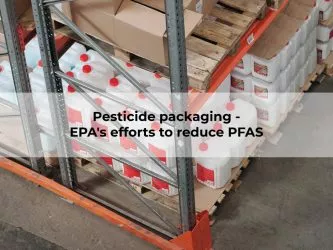
The U.S. Environmental Protection Agency (EPA) works diligently to address per-and polyfluoroalkyl substances (PFAS) in the environment. And, provides updates in testing pesticide products and containers for PFAS. As of 29 September 2021, The Environmental Protection Agency (EPA) releases a validated method for the detection of the presence of 28 PFAS compounds in oily matrices, such as pesticide products formulated with oil, petroleum distillate, or mineral oils. The US EPA modified Method 537.1 for the oily matrix Method. PFAS were previously detected in high-density polyethylene (HDPE) containers that were fluorinated by this method. It is mainly used for drinking water analysis. Testing oily matrix products for PFAS will be easier with the new method, according to pesticide manufacturers, state regulators, and other interested parties. They will be able to identify PFAS contamination. By encouraging companies to engage in good product stewardship and notify EPA if they find PFAS in their products, EPA hopes to eliminate PFAS from the environment. The EPA used this oily matrix method to assess three samples of stored mosquito control pesticides in collaboration with the Maryland Department of Agriculture. PFAS was not detected in any test sample at or above the Agency’s method limit of detection after the Agency thoroughly analyzed the samples and underwent a detailed quality assurance and quality control process. In terms of contamination, the Agency has only identified PFAS contamination in mosquito control pesticide products originating from fluorinated HDPE containers used in the storage and transportation of another mosquito control pesticide product. To determine the extent of the problem and its potential impact on public health and the environment, the EPA will use all available regulatory and non-regulatory tools. EPA will test for additional fluorinated containers containing PFAS in them. As part of its efforts to create awareness of this emerging issue and discuss expectations for product stewardship, EPA works with other federal agencies and trade associations. Additionally, the EPA encourages the pesticide industry to explore alternative packaging options, such as steel drums and non-fluorinated HDPE. State and local governments that could be affected by pesticide containers containing PFAS will continue to receive guidance from EPA, in collaboration with other federal agencies.
EPA plans for New Waste Water Regulation
On Sep 8, 2021, EPA released a Preliminary Plan 15, that identifies opportunities for better public Health protection and the environment protection through regulation of waste water pollution. Preliminary Plan 15 announced to take three new rulemaking to reduce the contaminants, mainly PFAS and nutrients, from industries. The preliminary plan is an effort by the EPA to reduce harmful PFAS (perfluoroalkyl or polyfluoroalkyl substances) levels found in wastewater treatment plants. The goal of this plan is to regulate PFAS chemicals entering public sewage treatment plants by establishing permissible levels for PFAS at one facility. The three new rulemakings will be initiated after conducting several studies as mentioned in Effluent Guidelines Program Plan 14. The agency has warranted revised Effluent Limitation Guidelines (ELG) and pre-treatment standards, to address PFASA and Nutrient discharges for: Organic Chemicals, Plastics and Synthetic Fibers category from facilities manufacturing PFAS. Metal Finishing category from Chromium electroplating facilities. Meat and Poultry Products category In particular, Preliminary Plan 15 proposes the following actions: to set new limitations for the Organic Chemicals, Plastics, and Synthetic Fibers industries to address the discharge of per- and polyfluoroalkyl substances (PFAS) from the PFAS manufacturing plants. to set new limitations for the Metal Finishing category to address PFAS discharges from chromium plating operations. to complete a detailed study of the Meat and Poultry Products and set new discharge standards for the industry. to publish a proposed Supplemental Rulemaking for the Steam Electric Power Generating industries. to initiate a detailed studies of PFAS discharges from the Landfills and Textile Mills industries. In addition, EPA’s Preliminary Plan 15 contains the results of studies of multiple industries, such as Metal Products and Machinery, Explosives Manufacturing, and Landfills, as well as an update on the PFAS Multi-Industry Study. PFAs stands for per- and polyfluoroalkyl substances. Its called Forever chemicals, because it gets accumulated in nature and Human body. EPA had already indicated in March, they have plans to regulate PFAS discharge, calling it a potential future rule making.