
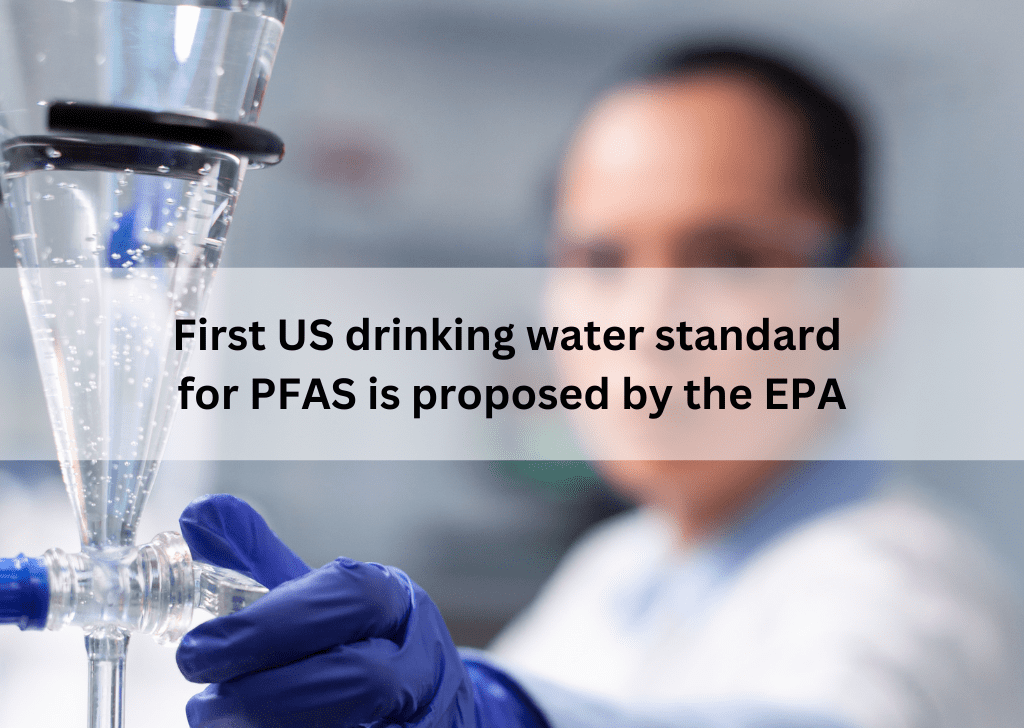
First US drinking water standard for PFAS is proposed by the EPA.
The US Environmental Protection Agency issued a proposed rule that would establish legally enforceable drinking water standards for six per- and polyfluoroalkyl substances (PFAS). A significant step has been taken towards setting the first enforceable federal standard for PFAS under the federal Safe Drinking Water Act (SDWA). PFAS compounds have come to be known as “forever chemicals” due to their propensity to stay permanently in the environment and toxicity at incredibly low concentrations. EPA’s move is expected to profoundly affect treatment requirements for drinking water suppliers and remediation clean-up requirements across a wide swath of federal and state environmental programs. EPA’s Proposed Regulation National Primary Drinking Water Regulation for six PFAS would be established by the proposed rule: perfluorooctanoic acid (PFOA) perfluorooctane sulfonic acid (PFOS) perfluorononanoic acid (PFNA) hexafluoropropylene oxide dimer acid (HFPO-DA) and its ammonium salt perfluorohexane sulfonic acid (PFHxS) perfluorobutane sulfonic acid (PFBS) and mixtures of these PFAS. The regulation seeks to establish legally-enforceable Maximum Contaminant Levels (MCLs) for these six PFAS in drinking water in the low parts per trillion—often called “non-detect” levels. In addition to enforceable levels, The EPA has concluded that PFOA and PFOS are probably carcinogenic to humans and has recommended MCLGs of 0.0 ppt. For any combination of PFNA, PFHxS, PFBS, and GenX Chemicals, the proposed MCLG is HI 1.0. These six chemicals that have been used in a variety of industries and consumer products, including firefighting foams, nonstick cookware, and waterproof clothing. If adopted, the proposed regulation will require public water systems to monitor for these chemicals. In addition, systems will be required to alert the public and lessen PFAS contamination if levels rise above the suggested regulatory limits. According to EPA, if fully implemented, the rule will, over time, prevent thousands of fatalities and lower the number of significant PFAS-related diseases by tens of thousands. This action establishes nationwide protection from PFAS pollution for all people, including environmental justice communities. In accordance with SDWA, the EPA Administrator must also submit a maximum contaminant level goal (MCLG) at the same time as the NPDWR. The MCLG is a non-enforceable public health objective that designates a point below which no known negative health impacts are anticipated. EPA is authorized to implement an NPDWR under SDWA based on its determination that these six PFAS may have severe effects on health, occur regularly and at levels that create public health concerns in public water systems, and that, in the Administrator’s sole discretion, their regulation affords a considerable opportunity for health risk reduction for those served by public water systems. According to EPA, if the rule is completely enforced, it will stop thousands of deaths and tens of thousands of significant PFAS-related diseases. The proposed drinking water standard for PFAS by the EPA would potentially affect a wide range of industries that use or have used PFAS in their products or processes. Some of the industries that could be impacted by the new standard include: Firefighting: PFAS-containing firefighting foams have been widely used for training and fire suppression, leading to PFAS contamination of soil and water. Chemical manufacturing: PFAS are used in the production of various chemicals, including plastics, coatings, and textiles. Consumer products: PFAS have been used in a wide range of consumer products, such as nonstick cookware, waterproof clothing, and food packaging. Electronics: PFAS are used in the production of semiconductors and other electronics components. Aerospace: PFAS-containing materials have been used in the aerospace industry for various applications, including fire suppression and hydraulic fluids. Automotive: PFAS are used in the manufacturing of some automotive components, such as brake pads and windshield wiper blades. Military: PFAS-containing firefighting foams have been used extensively by the military for training and fire suppression, leading to contamination of soil and water at military sites. The new drinking water standard would likely lead to increased regulation and scrutiny of these industries and their use of PFAS. Some industries may need to find alternatives to PFAS to comply with the new standard. However, some environmental and public health advocates have criticized the proposal, arguing that the MCL is not stringent enough to fully protect public health. These advocates have called for a more protective standard of 1 ppt or lower. The EPA is currently accepting public comments on the proposal, and a final decision is expected in 2024.
All you need to know about PFCAs restricted by EU under Annex 17
PFCAs (perfluorocarboxylic acids), a subset of PFAs (per- and polyfluoroalkyl substances) has been restricted by European commission – under Annex XVII of REACH Regulation. This new regulation replaces the entry 68 of Annex 17 to REACH on PFOA. PFOA related substances are now regulated under POPs regulation (EU) 2019/1021. It restricts the PFCAs and their salts, containing 9 to 14 carbon atoms in the chain (C9-C14 PFCAs). The below substances are excluded from the definition: CnF2n+1-C (= O) OX’ where n> 13 and X’=any group, including salts CnF2n+1-X, where X = F, Cl, or Br where n = 9, 10, 11, 12, 13 or 14, including any combinations thereof. Companies cannot manufacture, use or place the PFCAs and their salts on the market from 25th Feb 2023. These are toxic and very persistent and very bioaccumulative (vPvB). C9-C14 PFCAs act as a substitute for PFOA. This is also added under Candidate List as substances of very high concern (SVHCs) under REACH. It can be used as a constituent in other substances, mixtures or articles, if the mixture, or the article is below 25 ppb for the sum of C9-C14 PFCAs and their salts or 260 ppb for the sum of C9-C14 PFCA-related substances. The regulation is applicable from 4th July 2023 to: Textiles for oil – and water repellency for protection of workers from dangerous liquids. The manufacturer of polytetrafluoroethylene (PTFE) and polyvinylidene fluoride (PVDF), used in the production of: Industrial sealants capable of preventing volatile organic compound leakage. Equipment for industrial waste heat exchange. Membranes used in corrosion resistant gas filters, water filters and medical devices. The regulation is applicable from 4th July 2025 for: Photographic coatings applied to films. Implantable and invasive medical devices. Fire-fighting foam for liquid fuel vapor suppression and liquid fuel fire for Class B fires. photolithography or etch processes used in the manufacture of semiconductors. Different transition periods are granted to certain industry and professional. Articles placed before 25th of Feb 2023 on EU market are exempted. Talk to one of our REACH Regulation Specialists today!