
Upcoming PFAS Restriction Proposal: Everything You Need to Know
In response to growing concerns about the environmental persistence and potential health risks of per- and polyfluoroalkyl substances (PFAS), the European Chemicals Agency (ECHA) is taking action within the ambit of REACH, the European Union’s regulatory framework for chemicals. PFAS, known for their unique properties like resistance to heat, water, and oil, are extensively utilized across various industries. Yet, their durability and possible adverse effects on health have prompted urgent regulatory scrutiny. Problem: The contamination caused by PFAS is linked to numerous health problems, such as cancer, immune system disturbances, and developmental issues. Due to their environmental persistence, PFAS accumulate in living organisms and extensively contaminate water, soil, and wildlife. The lack of thorough regulatory measures has enabled PFAS to permeate a wide range of consumer goods, industrial activities, and materials, thereby presenting significant threats to human health and the ecological balance. Solution: Upcoming Meetings: March 2024: Discussions on PFAS hazards in consumer mixes, cosmetics, and ski wax (reported by RAC) and the general strategy (exclusive to SEAC). June 2024: Debate on risks in metal plating and metal goods production (by RAC). September 2024: Focus on petroleum and mining, food contact materials and packaging, and textiles, furniture, leather, clothes, and carpets (TULAC). The repercussions : ECHA’s proactive approach towards evaluating and potentially restricting PFAS under REACH underscores a commitment to tackling emerging chemical risks and safeguarding human health and the environment. Collaboration among regulatory authorities, scientific committees, industry stakeholders, and the public is paramount to ensuring the effectiveness and feasibility of proposed PFAS restrictions. ComplianceXL aids businesses in achieving PFAS regulatory compliance by compiling pertinent data related to PFAS for their products. Moreover, we offer ongoing maintenance services to ensure the integrity and currency of regulatory documentation for our clients moving forward. FAQs: Q: What specific sectors are being addressed in the upcoming committee meetings? A: The sectors under discussion include consumer mixtures, cosmetics, ski wax, metal plating, metal product manufacturing, textiles, upholstery, leather, apparel, carpets, food contact materials, packaging, petroleum, and mining. Q: How will feedback from the consultation process be incorporated into the proposal? A: The five national authorities responsible for the proposal will revise and update it based on the comments received during the consultation. This updated proposal will serve as the foundation for the scientific committees’ evaluations and subsequent recommendations.
First US drinking water standard for PFAS is proposed by the EPA.
The US Environmental Protection Agency issued a proposed rule that would establish legally enforceable drinking water standards for six per- and polyfluoroalkyl substances (PFAS). A significant step has been taken towards setting the first enforceable federal standard for PFAS under the federal Safe Drinking Water Act (SDWA). PFAS compounds have come to be known as “forever chemicals” due to their propensity to stay permanently in the environment and toxicity at incredibly low concentrations. EPA’s move is expected to profoundly affect treatment requirements for drinking water suppliers and remediation clean-up requirements across a wide swath of federal and state environmental programs. EPA’s Proposed Regulation National Primary Drinking Water Regulation for six PFAS would be established by the proposed rule: perfluorooctanoic acid (PFOA) perfluorooctane sulfonic acid (PFOS) perfluorononanoic acid (PFNA) hexafluoropropylene oxide dimer acid (HFPO-DA) and its ammonium salt perfluorohexane sulfonic acid (PFHxS) perfluorobutane sulfonic acid (PFBS) and mixtures of these PFAS. The regulation seeks to establish legally-enforceable Maximum Contaminant Levels (MCLs) for these six PFAS in drinking water in the low parts per trillion—often called “non-detect” levels. In addition to enforceable levels, The EPA has concluded that PFOA and PFOS are probably carcinogenic to humans and has recommended MCLGs of 0.0 ppt. For any combination of PFNA, PFHxS, PFBS, and GenX Chemicals, the proposed MCLG is HI 1.0. These six chemicals that have been used in a variety of industries and consumer products, including firefighting foams, nonstick cookware, and waterproof clothing. If adopted, the proposed regulation will require public water systems to monitor for these chemicals. In addition, systems will be required to alert the public and lessen PFAS contamination if levels rise above the suggested regulatory limits. According to EPA, if fully implemented, the rule will, over time, prevent thousands of fatalities and lower the number of significant PFAS-related diseases by tens of thousands. This action establishes nationwide protection from PFAS pollution for all people, including environmental justice communities. In accordance with SDWA, the EPA Administrator must also submit a maximum contaminant level goal (MCLG) at the same time as the NPDWR. The MCLG is a non-enforceable public health objective that designates a point below which no known negative health impacts are anticipated. EPA is authorized to implement an NPDWR under SDWA based on its determination that these six PFAS may have severe effects on health, occur regularly and at levels that create public health concerns in public water systems, and that, in the Administrator’s sole discretion, their regulation affords a considerable opportunity for health risk reduction for those served by public water systems. According to EPA, if the rule is completely enforced, it will stop thousands of deaths and tens of thousands of significant PFAS-related diseases. The proposed drinking water standard for PFAS by the EPA would potentially affect a wide range of industries that use or have used PFAS in their products or processes. Some of the industries that could be impacted by the new standard include: Firefighting: PFAS-containing firefighting foams have been widely used for training and fire suppression, leading to PFAS contamination of soil and water. Chemical manufacturing: PFAS are used in the production of various chemicals, including plastics, coatings, and textiles. Consumer products: PFAS have been used in a wide range of consumer products, such as nonstick cookware, waterproof clothing, and food packaging. Electronics: PFAS are used in the production of semiconductors and other electronics components. Aerospace: PFAS-containing materials have been used in the aerospace industry for various applications, including fire suppression and hydraulic fluids. Automotive: PFAS are used in the manufacturing of some automotive components, such as brake pads and windshield wiper blades. Military: PFAS-containing firefighting foams have been used extensively by the military for training and fire suppression, leading to contamination of soil and water at military sites. The new drinking water standard would likely lead to increased regulation and scrutiny of these industries and their use of PFAS. Some industries may need to find alternatives to PFAS to comply with the new standard. However, some environmental and public health advocates have criticized the proposal, arguing that the MCL is not stringent enough to fully protect public health. These advocates have called for a more protective standard of 1 ppt or lower. The EPA is currently accepting public comments on the proposal, and a final decision is expected in 2024.
New York joins in the club of PFAS substance’s ban in Apparels and Clothing
What is PFAS? PFAS, or per- and polyfluoroalkyl substances, are a group of manufactured chemicals that have been widely used in a variety of industrial and consumer products that leads to cause health problems such as cancer, liver damage, and developmental issues. As a result, US (United States) Environmental Protection act (EPA) has taken the necessary actions which as follows. Developing new drinking water standards for PFOA and PFOS, two of the most well-studied PFAS compounds. PFAS monitoring in public water systems is required New York PFAS restriction: New York also started banning of per-and polyfluoroalkyl substances which are comes up in clothes and apparels after California’s steps. The New York has banned the PFAS’s substances in food packaging will be effective from December 31st, 2022. After that on December 30th, 2022, Kathy Hochul who is New York Governor has signed a bill which will help to restrict the PFAS’s substances in Clothing and apparels effectively by December 31st, 2023. Even on last year Q3, California’s government has banned the PFAS substances in Clothing. The Golden States’ law also starts restricts the PFAS Substances on the Sales & Distribution on Clothing’s & apparels effectively by Jan 1st, 2025. Compared to California’s laws and some other similar laws, New York Law is less detailed. There are few details about finding the alternate with less toxic where are California’s Law prescribes the submission of ‘Certificate of Compliance’ by the distributors and manufactures. The main difference between the two laws is, both intended to restrict the use of PFAS Substances in Clothing where California also address the use of PFAS substance levels 100ppm by 2025 & 50 ppm by 2027. While other states laws also restrict the PFAS in garments which included California & Washington in addition to their existing regulations. And Vermont and Massachusetts states could affect the PFAS garments with pending legislation. However, this Law is not applicable to the Professional uniforms or the outerwear which are intended for extreme conditions. The detailed instructions will release to explain this law which will address both the dangerous firefighting and wet-weather conditions. However, for now, PFAS will provide double functionality in firefighter clothing, as it can be used as flame-suppression foams and fire-suppressive clothing. In addition, PFAS also have a water-resistance, which means the material does not become wet and heavy while being used. This bill going to ban the use of PFAS substances in all clothing’s by December 31st, 2023. A better understanding of the use of PFAS in apparel products is still developing, but New York apparel companies will need to ramp up their analysis in order to meet the December 31, 2023, compliance deadline.Speak with our PFAS specialists if you would like more information about these chemicals and the potential regulatory and litigation risks associated with them.
All you need to know about PFAS restrictions proposed to ECHA
On 12th January 2023, ECHA received PFAS restriction proposals from Germany, Norway, Denmark, and Sweden authorities in line with the EU’s Chemicals Strategy. The main goal is to reduce PFAS emissions into the atmosphere and make sure that the products are safe to use. The polyfluoroalkyl substances (PFASs) are available on ECHA’s website and they are currently reviewing and evaluating these proposals with respect to the environmental impact and risks caused to people. The environment, animals, and people will be affected if their releases are not restricted. If the PFASs are not restricted, 4.4 million tonnes of PFASs will be released into the environment. ECHA’s director said “Currently, there are five authorities working towards zero pollution plans with the agreement of the EU’s chemicals strategy. The scientific committees will begin their evaluation but evaluating thousands of substances poses many challenges”. ECHA’s scientific committees for Risk Assessment (RAC) and for Socio-Economic Analysis (SEAC) will start reviewing these proposals and checking if they satisfy the requirements of REACH. If it meets their requirements, they will start the evaluation process at the upcoming meeting in March 2023. RAC will provide an opinion on the proposals with respect to the reduction of risks to the environment and people’s health. The SEAC’s opinions will also be considered based on the costs incurred by society. Both committees’ opinions will be considered and will be sent to the European Commission who decides to restrict. Below are the next steps for PFAS restriction proposals: 13th Jan 2023 – Restriction Proposal Submitted to ECHA 7th Feb 2023 – Proposal made available on ECHA’s website 22nd Mar 2023 – Start of a six-month open consultation 5th Apr 2023 – Online information session ECHA committees’ evaluation ECHA’s committees adopt their opinions Opinions of ECHA’s committees sent to the European Commission We ensure that our clients are always in compliance with global regulations and always operate responsibly and sustainably. With our comprehensive solutions, organizations can comply with PFAS requirements, including assessments of their current compliance status, customized training programs to make sure employees remain knowledgeable about the latest regulations, and reporting services to ensure that all necessary documentation is completed accurately and timely. Call us today to learn more about PFAS ComplianceXL!
Are you aware of the ECHA’s new proposal to ban PFASs in firefighting in Europe?
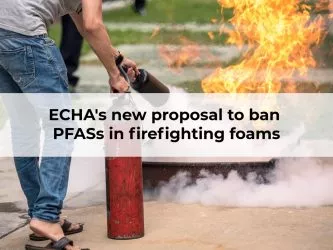
PFAS (per- and polyfluoroalkyl substances) are synthetic chemicals with a wide range of applications in a variety of industries. They are based on the carbon-fluorine bond chemicals and are considered to be the strongest bonds. The stable properties of these materials make them useful for many applications, including food processing, electronics, aerospace, and medical devices. A new trend is replacing long chain bonds with small chain bonds because they are more resistant to degradation, thus reducing human health and environmental impact. Chemicals such as PFAS have the potential to harm humans and the environment through direct or indirect releases through food (example: fish from PFAS contaminated waters), skin contact (use of cosmetics containing these harmful substances), and also through air pollution. According to studies, approximately 18,000 tons of firefighting foam are expected to be sold in the EU each year. Approximately 470 tons of PFAS are contained in these 18,000 tons. In the absence of proper treatment, soil and water might be contaminated. In order to prevent contamination of water and soil and human health risks, ECHA has drafted a proposal for a ban on all PFASs in firefighting foams across the EU. Next steps as per ECHA: A committee of ECHA members will analyze the proposal’s risk assessment. Analyze the socio-economic impact of the proposed ban and the various options for limiting it. After the assessment, what should you do?: A final assessment will be completed by the ECHA committee in 2023. Defining transition periods and timelines for industry to choose suitable alternatives. For non-alternative options, guidelines such as limiting PFAS releases to the environment should be followed. Describe how disposal should be considered after use. In January 2023, five EU countries will submit proposals for Ban: Denmark, Sweden, Norway, Netherlands, and Germany. As a result of PFAS restrictions on firefighting foams, those PFASs are also restricted in broader applications and uses. Combined with automated platform technology, ComplianceXL reduces your workload and gives you hours back in your day by giving you back time on your hands. It is essential to maintain agility when navigating issues like the PFAS restrictions. Get in touch with ComplianceXL for more information about how PFAS may affect your business.