
WEEE Directive Updates : Ensuring Compliance in Electronics Recycling
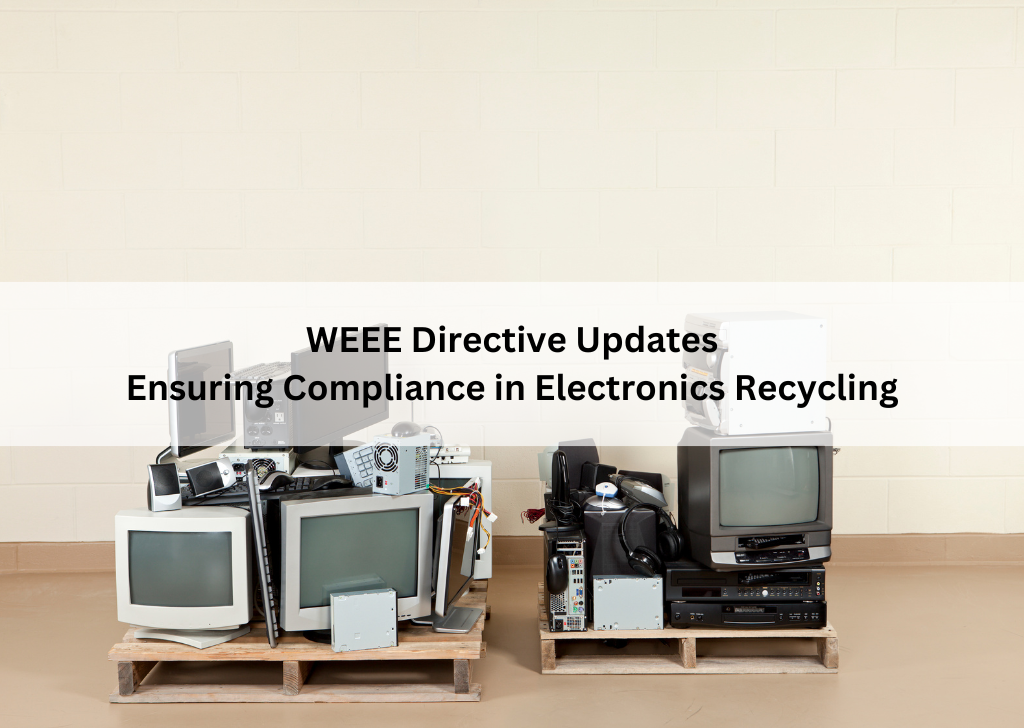
Electronics are a big part of our lives, but we need to know what happens when they stop working The EU’s updated WEEE Directive is making sure we handle that waste more responsibly. With new rules coming into effect by October 2025, companies that make or sell electronics need to step up their recycling game. It’s not just about following regulations—it’s about protecting the planet and doing business the right way. The main goal of the updated WEEE Directive is to make electronics recycling more effective, fair, and environmentally responsible. As technology evolves, so do the types of electronic products we use—and discard. This update aims to ensure that everyone involved in the lifecycle of these products, from manufacturers to retailers, takes proper responsibility for their disposal. By clarifying roles, improving transparency, and expanding the scope to include newer devices like solar panels, the directive encourages businesses to adopt greener practices. Ultimately, it’s about reducing electronic waste, protecting natural resources, and creating a more sustainable future for all. The updated WEEE Directive is a big step forward in making electronics recycling smarter and more sustainable. For businesses, it means clearer rules and fewer surprises—helping them avoid fines and stay compliant. For the environment, it’s a win: less harmful waste ends up in landfills, and more valuable materials get reused. This also supports the circular economy, where old electronics can be turned into new products instead of being thrown away. And for all of us, it means cleaner communities and a healthier planet. The impact is wide-reaching, encouraging everyone—from manufacturers to consumers—to think more responsibly about the life cycle of electronic products. As a trusted partner in regulatory compliance, Compliance XL helps businesses understand their responsibilities, manage registrations, and stay on top of reporting requirements. Their expert support ensures companies don’t just meet the October 2025 deadline—they do so confidently and correctly. By simplifying complex regulations and offering tailored solutions, Compliance XL empowers organisations to focus on what they do best, while contributing to a cleaner, more sustainable future. FAQs:
The RoHS and WEEE directives – recent developments

Electrical and component engineering companies exporting products to the EU are heavily governed by ROHS/WEEE legislation. As this effects companies located outside of the Union, it is essential to keep up to date with the latest changes, and have an effective master data management scheme that includes obsolescence management tools. RoHS/WEEE legislation is a complex area, but an essential one for PCB designers and component manufacturers, as it covers areas like tin-lead solders and semiconductor finishes. Both directives are in the process of being revised. It’s important to realize that the laws simply act as a template, and that each European country may have its own specific regulations. These can vary considerably between borders and be changed at any time, so it’s vital you keep stringent, up to date records, especially when dealing with different export destinations. The US Department of Commerce has a web portal (Buy USA Gov) to assist US engineering companies and component engineering firms exporting EEE (electrical and electronic equipment) to Europe. A valuable resource, it has country-by-country information on RoHS/WEEE implementation, and issues regular news updates. The latest news concerns revisions to the RoHS directive, which took place on November 24, 2010. A key change was the extension of the directive to cover all electrical and electronic equipment, apart from that covered by exclusions, with a transitional period of 8 years. A 3-year impact assessment plan has been suggested with an 18-month period before the changes become legally binding, but the implications are obvious. We at Enventure Technologies have a number of enterprise data management solutions in the area of environmental compliance, covering ELV, GADSL, ROHS, WEEE and REACH regulations.
REACH EU and US Defense Exports – The Continuing Saga

ROHS, WEEE and REACH regulations may be European initiatives, but their influence is far-reaching. The EU is a major importer of products produced outside the European Union which come under its environmental compliance laws. These range from agricultural chemicals to FPGA designs. Here, we address the latest developments in REACH compliance as it applies to defence. REACH legislation governs the import and production of chemical substances within the EU. Certain products produced for the defence industry are exempt. However, exemption decisions were very much made on a national basis, and varied between member states. It became obvious to the EDA (European Defence Agency) that REACH compliance required a more harmonised approach. Creating a transparent, open European Defence Market aligning national exemption policies would considerably simplify matters for component manufacturers and other producers, not least those wishing to export into the European Union. In March 2010, the pMS (participating Member States) of the EDA agreed a Steering Board Decision which set common standards for REACH exemptions in the defence industry. A public web portal was also established to provide transparency over national policies and procedures. The PMS are now in the process of adopting the new international standards, which will be reviewed annually starting in 2011. In realisation of the fact that the REACH Regulation affects non-member countries of the EDA, such as the US and Canada, the Steering Board invited these “third member” states to adopt the new REACH legislation principles, further harmonising the process of supply. The Steering Board decision is a promising development in a controversial and confusing area. We at Enventure Technologies offer a number of solutions to help you cope with the complexities of ROHS, WEEE and REACH legislation.
When WEEE Compliance Can Cause Problems For Hardware Designers
The RoHS WEEE directive specifically forbids the use of lead in electronic components, unless the lead content is 0.1% or lower. This has effectively seen the end of tin lead (SnPb) finishes to a large extent, as component manufacturers switch to non-lead finishes. Some categories – for example, medical instruments and FPGA design for monitoring and control – were exempt. However, these exemption dates are coming to a close, causing headaches for mechanical engineering companies such as medical suppliers and aerospace firms. Many applications are committed to using SnPb components – often, the product lifespan covers decades, rather than years – forming major problems in obsolescence management if component manufacturers suddenly stop making them. It’s not always as easy as switching to a non-lead finish. The impact of using lead-free component technology in the aerospace industry was considered so serious that it led to the formation of the Lead-free in Aerospace Project (LEAP) working group, in partnership with the Aerospace Industries Association Government Electronics and Information Technology Association (GEIA). LEAP is an international group which includes members from both the EU and USA. It includes representatives from the world’s major aircraft and defence contractors, as well as mid-tier component manufacturers and mechanical engineering companies. When you’re building military aircraft, obsolescence management has to be tightly controlled, and the LEAP-WG has been feverishly working since before the RoHS directive was ever introduced, developing guidelines and acceptable lead-free practices for the aerospace industry. With the right obsolescence management tools, you can always be prepared. If you have RoHS/ WEEE worries, we at Enventure Technologies have solutions you can trust.
What is the WEEE Directive?
At Enventure, as part of our environmental compliance services, we can ensure that your organization meets the WEEE directive, which will help you avoid any costs associated with non-compliance as well ensuring that you reach compliance expediently. But what exactly is the WEEE directive, and how can we help you meet the challenge of WEEE compliance? The WEEE legislation – or Waste Electrical and Electronic Equipment Legislation – is legislation that has been devised in order to ensure that the waste associated with electrical and electronic equipment is not only handled correctly but actively reduced, through a proper recycling strategy. WEEE directive compliance isn’t just an arbitrary legal requirement therefore, but has a clear goal. Meeting WEEE compliance is not just a legal issue, but has an ethical dimension. With this in mind, it is doubly important that your organization meets WEEE compliance effectively – which is where our environmental compliance services can help. One of the key challenges with environmental compliance is one of complexity of data, and therefore as part of our WEEE compliance services we offer a consultation solution, which will help you to identify exactly what wee compliance means for your business, and get you well on your way to reaching regulations. We will also help you to manage information relating to WEEE compliance in relation to your operations, which is essential in giving manufacturers a substance level knowledge of their production lines relating to compliance – which will help them to identify better and more effective ways to reach WEEE compliance in the long term. Whilst WEEE compliance can be complex, with the right consultation strategy and approach, successful WEEE compliance cannot only be easy but cost effective, too.
WEEE compliance
The WEEE directive compliance legislation is something almost any company that lists a computer or a piece of electronics in their assets will need to deal with eventually. For those engaged in manufacturing or selling anything with electronic or electrical components, this is one of the key components of environmental compliance management. WEEE stands for Waste Electrical and Electronic Equipment. An old computer isn’t just a heavy piece of rubbish when it reaches the end of its life. While its exterior may consist of glass, metal, and plastic, what’s inside can be quite hazardous. Older batteries are especially problematic, and if waste electronics go straight to landfill, chemicals like lead and mercury can leach out and end up polluting the soil and the water table. Private individuals can sometimes send their broken and dead laptops and computers back to the manufacturer for safe disposal, but for the manufacturers themselves WEEE compliance can be a headache. Of course, they’ll also have to stay within other directives as well – many of the raw materials used to make electronic components include mercury and other chemicals covered by the Restriction of Hazardous Substances (RoHS) directive for example. Specialists like us can make sure your manufacturing company comes into environmental compliance of all kinds and stays that way. We understand WEEE, RoHS, REACH and others. With a software solution and the right staff training compliance is easy. We can also make sure it happens as efficiently as possible, so your workers can continue to add value to your business.
Do You Need to Worry about WEEE Compliance?
In this entry, we thought we would look briefly at the European Waste Electrical and Electronic Equipment Directive (or conveniently WEEE compliance) and why this environmental compliance directive may apply to you. WEEE is there to try and encourage the collection, recycling and recovery of all or parts of waste electronic or electrical apparatus. This is an EU directive which is implemented slightly differently by the various member nations, but in general if you are dealing in large or small household appliances, IT and telecoms equipment, consumer equipment, lighting equipment, electrical (and electronic) tools, electrical toys, leisure or sport equipment, medical devices, monitoring and control instruments and automatic dispensing machines then this recycling directive will apply to you. There are exceptions for things like implanted (or infected) equipment, large scale industrial tools that don’t ever move, military products, automotive and aerospace or aircraft products or the oddly described “surface transportation products”. If your company does manufacture anything that comes into the list of covered products then you need to register as a WEEE producer and you need to provide people who buy your products a means of returning the old items to you for recycling. You also need to make sure you are very open about how you are doing this recycling and cover all the costs associated with this. One of the easiest ways of doing this, and for most companies this would be the most convenient is to employ an external company who specialize in all the things associated with WEEE Compliance. They will also be able to advise you on your responsibilities and liabilities so it is worth chatting to one at the very least.