
EU Green Deal and Its Transformative Impact on the Cosmetics Industry
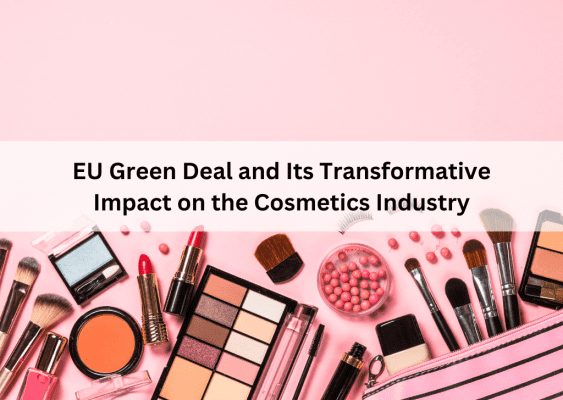
According to a recent study by Cosmetics Europe, 72% of European consumers highly value cosmetics and personal care products in their daily lives. These products, ranging from lotions to powders, not only enhance skin appearance and scent but also play a significant role in cleansing, protecting, and moisturizing the skin. With the potential to improve the quality of life, boost self-esteem, and facilitate social interactions, it is essential to ensure that cosmetic products and their ingredients are environmentally safe. The European Green Deal and Its Implications: As the world faces alarming climatic challenges, maintaining a healthy climate has become a top priority for individuals worldwide. Europe, as a continent, has taken a significant step in this direction with the initiation of the European Green Deal. This proposal aims to transform the EU into an eco-friendly and competitive economy by generating a new growth strategy. By 2050, the European Green Deal envisions achieving net-zero greenhouse gas emissions. While the EU cosmetic industry embraces the Green Deal and its goals, it also acknowledges the challenges that accompany its implementation. Protecting Consumer Safety and Health: The primary objective of cosmetic safety assessment within the EU is to safeguard consumer health and safety. Since cosmetics, including skincare, haircare, makeup, and personal hygiene products, come into direct contact with the skin and mucous membranes, it is vital to ensure that they do not contain non-compliant ingredients or formulations that could lead to adverse reactions, allergies, or even serious health hazards. Cosmetics Europe’s Suggestions for Enhanced Safety and Compliance: To prevent unnecessary negative impacts, Cosmetics Europe has outlined several factors that the European Commission should consider when revising the current Cosmetic Products Regulation (CPR). These propositions include promoting a globally sustainable competitive cosmetics sector, fostering entrepreneurship and innovation, and strengthening the effectiveness of the CPR. Additionally, Cosmetics Europe emphasizes the need to maintain the “Gold Standard” of the CPR as an international reference, given the history of high safety levels achieved by European cosmetic products. The Impact on Cosmetic Ingredients and Packaging: Within this initiative, the focus on cosmetic ingredients and packaging becomes evident. Companies will now be encouraged to invest in cosmetic raw materials and packaging that are both safe for consumers and sustainable for the environment throughout their lifecycle. Holistic assessments based on scientific evidence will be crucial to determine the environmental impact caused by cosmetic and personal care products. By implementing rigorous safety assessments, the EU aims to minimize potential risks and build consumer trust. Benefits and Expectations: The EU’s commitment extends to transforming the economy for a sustainable future, improving the climate by 2030 and 2050, and fostering research and innovation in the cosmetics industry. The ambition is to have a toxic-free environment with zero pollution, as well as the preservation and restoration of ecosystems and biodiversity. This initiative empowers consumers to embrace the green and digital transitions. As the cosmetics industry continues to evolve dynamically, it has an important role to play in environmental initiatives. While the implementation of the European Green Deal is still in its initial phase, the upcoming regulatory changes in the cosmetics and consumer industry are inevitable. By prioritizing safety, compliance, and sustainability, the industry will continue to deliver safe, compliant, and effective products. The EU Green Deal sets high expectations for the industry’s contribution towards a greener future, making it essential for companies to align with its principles for long-term success. As the regulatory landscape evolves with the EU Green Deal,it becomes crucial for businesses to stay compliant with established regulations in the EU market. ComplianceXL provides a wide range of compliance services to assist organizations in effectively managing compliance requirements. Our team of experts will guide your company in complying with storage and disposal regulations to ensure a safe and accident-free environment. Contact Compliance XL today for efficient and hassle-free compliance services. FAQs 1. What is importance of the EU Green Deal? The European Green Deal is a package of policy initiatives, which aims to set the EU on the path to a green transition, with the goal of reaching climate neutrality by 2050. It supports the transformation of the EU into a fair and prosperous society with a modern and competitive economy. 2. What is green deal with the EU? The European Green Deal – A commitment to future generations. No net emissions of greenhouse gas emissions by 2050. Economic growth decoupled from resource use. No person and no place left behind. 3. How many countries are in the European Green Deal? 27 EU countries are preparing for 2050. The European Union’s investment and reform plan to achieve zero emissions in mobility, agriculture, construction, and industry. Contact one of our compliance specialists today!!! Contact Us
Driving Excellence: Power of Automotive Core Tools

Among the Automotive Core Tools, there are methodologies that assist manufacturers and suppliers in adhering to IATF 16949, the standard for quality management systems in the automotive industry set by the International Automotive Task Force. The Automotive Core Tools encompass: Advanced Product Quality Planning & Control Plan (APQP): APQP guides the development of new or improved products and processes, ensuring they align with customer expectations. Production Part Approval Process (PPAP): This process aims to confirm a supplier’s ability to manufacture parts that meet specified customer requirements and quality standards. Failure Mode and Effects Analysis (FMEA): This tool identifies and assesses potential failures, providing recommendations to prevent or mitigate them. A recently harmonized FMEA manual combines the best practices of AIAG and VDA, two industry associations. Statistical Process Control (SPC): Utilizing statistical methods and charts, SPC monitors and manages the variation of critical process parameters. Measurement System Analysis (MSA): MSA evaluates the accuracy and precision of measurement systems, pinpointing sources of measurement errors and variability. The following outlines the advantages and disadvantages of automotive core tools: The advantages are: Ensuring quality, reliability, safety, and customer satisfaction within the automotive sector. Reducing costs, waste, defects, and risks. Facilitating conformity with IATF 16949, the international quality management standard in the automotive industry. Demonstrating competence and compliance with customer and regulatory prerequisites. Enhancing manufacturing efficiency, labor productivity, and materials management. The disadvantages are: Effective implementation necessitates substantial training, certification, and software usage. May not readily accommodate changes in market trends, customer needs, or product innovations. Compatibility concerns with other quality tools and techniques used in different industries or sectors. Possible inadequacy in addressing all quality challenges within the automotive industry. Automotive Core Tools serve various purposes: The APQP process guarantees adherence to requirements and the avoidance of potential issues throughout product development, from concept to launch. PPAP ensures suppliers can deliver parts in line with design specifications, quality standards, and customer demands. FMEA identifies and prioritizes potential failure causes and effects, subsequently implementing corrective or preventive actions. Statistical Process Control aids in identifying and eliminating sources of process variation, whether common or specific, through measurement and analysis. MSA improves measurement system accuracy, reliability, and consistency while minimizing measurement errors and variations. ComplianceXL employs these Automotive Core Tools to provide clients with services concerning diverse regulations, contributing to the automotive industry’s quality, reliability, safety, and customer satisfaction. This approach offers customers a risk-free, cost-effective solution, enabling the automotive sector to uphold regulatory compliance and competitive strength. Contact one of our Automotive compliance specialists today! Contact Us
ComplianceXL to provide Material, Compliance Consulting and Training for a leading manufacturer of Aerospace components in the US

Chicago, IL; November 20, 2019 – ComplianceXL today announced that a leading aerospace component manufacturer awarded the compliance service contract to support its compliance stakeholders in consulting and enable them to comply with global material compliance. The client is a one of the largest manufacturers of aerospace composite structures, for defense, carbon fiber tubing, and commercial carbon. Their filament winding and molding operations will focus on producing lasting, high-performance composite structures while controlling costs. The project kicks off with ComplianceXL performing a compliance gap assessment for major regulations such a RoHS, REACH, Prop65, Conflict Minerals, WEEE, CLP and CE to identify the gaps in the compliance needs. The senior compliance consultant will design a framework to fulfill the aspects of each of the compliance across products/components manufactured. ComplianceXL will also provide compliance training to all key stakeholders on the RoHS, REACH, Prop65, Conflict Minerals, WEEE, CLP and CE regulations to perform internal compliance audits for the products/ processes and component/ chemical suppliers and quote. Environmental concerns are a hot topic to discuss across the global and industries. The effort of manufacturers towards being compliant to regulations is immense and we dedicate ourselves to enable such companies with a solution that is flawless. We are proud to work with an aerospace industry participant and support client to drive sustainable business solutions that help address environmental concerns and quote says C. K. Bharathan, Head – Compliance Solutions, ComplianceXL. About Compliance XL: ComplianceXL is the Compliance Solutions Division of Enventure, a leader in the compliance business since 2003. ComplianceXL is a one-stop solution for all supply chain compliance requirements, ranging from consulting and training to software deployment and compliance documentation. By implementing a transparent and well-structured compliance program, ComplianceXL enables clients and all key stakeholders to follow an integrated process, to meet obligations. Beyond an initial implementation, also provides ongoing support to comply with all regulations by keeping you updated with the latest directives.
What is the WEEE Directive?

At Enventure, as part of our environmental compliance services, we can ensure that your organization meets the WEEE directive, which will help you avoid any costs associated with non-compliance as well ensuring that you reach compliance expediently. But what exactly is the WEEE directive, and how can we help you meet the challenge of WEEE compliance? The WEEE legislation – or Waste Electrical and Electronic Equipment Legislation – is legislation that has been devised in order to ensure that the waste associated with electrical and electronic equipment is not only handled correctly but actively reduced, through a proper recycling strategy. WEEE directive compliance isn’t just an arbitrary legal requirement therefore, but has a clear goal. Meeting WEEE compliance is not just a legal issue, but has an ethical dimension. With this in mind, it is doubly important that your organization meets WEEE compliance effectively – which is where our environmental compliance services can help. One of the key challenges with environmental compliance is one of complexity of data, and therefore as part of our WEEE compliance services we offer a consultation solution, which will help you to identify exactly what wee compliance means for your business, and get you well on your way to reaching regulations. We will also help you to manage information relating to WEEE compliance in relation to your operations, which is essential in giving manufacturers a substance level knowledge of their production lines relating to compliance – which will help them to identify better and more effective ways to reach WEEE compliance in the long term. Whilst WEEE compliance can be complex, with the right consultation strategy and approach, successful WEEE compliance cannot only be easy but cost effective, too.