
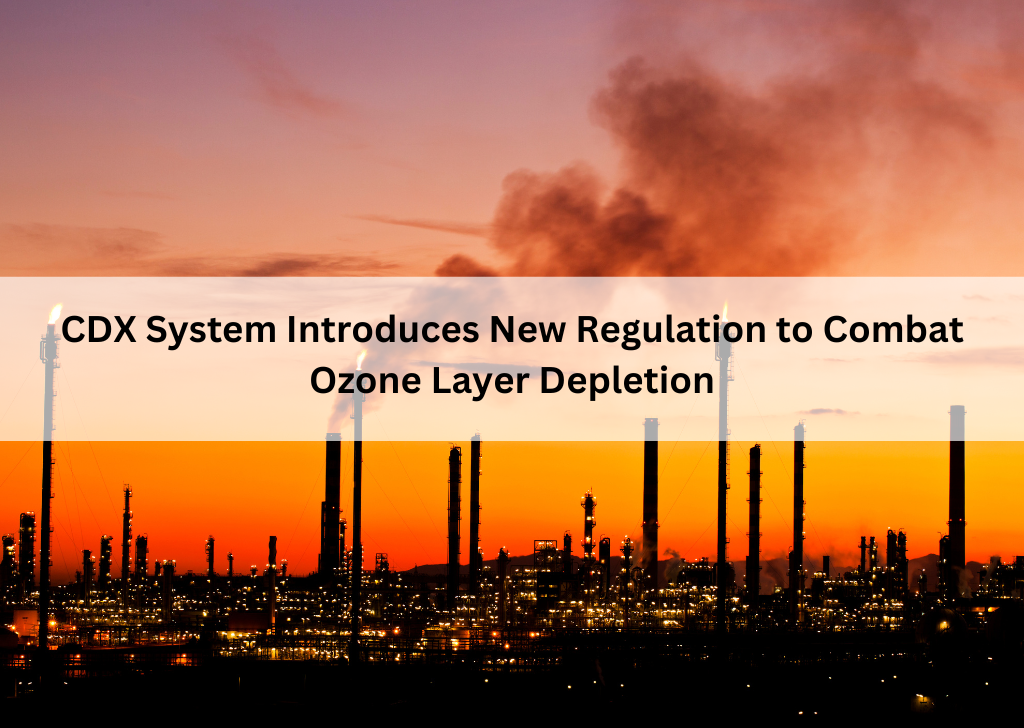
CDX System Introduces New Regulation to Combat Ozone Layer Depletion
The Montreal Protocol, finalized in 1987, is a landmark international agreement aimed at protecting the stratospheric ozone layer by phasing out the production and consumption of substances that deplete it. These ozone-depleting substances (ODS), including hydrochlorofluorocarbons (HCFCs), halons, carbon tetrachloride (CCl4), methyl chloroform, methyl bromide (MeBr), bromochloromethane, and hydrobromofluorocarbons (HBFCs), are commonly found in refrigerators, air conditioners, and fire extinguishers. In November 2018, the parties to the Montreal Protocol agreed to promote the exchange of information on the best technologies for ODS destruction, a list that was later expanded in accordance with the protocol. The Chemical Data Exchange (CDX) system adopted this rule on January 4, 2024, to bolster the commitment to regulatory compliance among its users. Key Highlights: The additional criteria from the 2002 Technology and Economic Assessment Panel (TEAP) report include specifications to evaluate destruction technologies (DRE) that countries might consider for domestic use. The DRE for diluted sources is set at 95%, and for concentrated sources at 99.99%. Emissions of polychlorinated dibenzodioxins (PCDDs) and polychlorinated dibenzofurans (PCDFs) are capped at 0.5% for diluted sources and 0.2% for concentrated sources. The release of hydrochloric acid (HCl) and chlorine (Cl2) is restricted to 100% for both source types, while hydrobromic acid (HBr) and bromine (Br2) emissions are limited to 5%. Carbon oxide emissions are held at 100% for both diluted and concentrated sources. This update in the CDX system to include ODS, as per Annexes A-F with a phase-out schedule, aligns with the Environmental Protection Agency (EPA) regulations and reflects the ongoing evolution of chemical substance protocols. This integration is designed to assist businesses in adhering to these crucial environmental standards, with the adjustments being phased in over the coming periods. For the latest insights on the CDX system and its upcoming regulatory updates, keep an eye on ComplianceXL’s blogs. If you have questions or need help navigating the CDX system, the ComplianceXL team is always at your service, ready to offer expert guidance and support.
All you need to know about Compliance Data Exchange

The Compliance Data Exchange (CDX) is an online product data management system developed and supported by DXC Technology. It is a cloud-based Software as a Service system (SaaS), centrally operated by CDX platform. CDX system helps you to collect, analyse and manage materials data throughout the entire supply chain and successfully supports the material management system across multiple industries. It also has an advantage of supporting the conflict minerals with the same CDX system. Why CDX The CDX is created with the vision to provide complete solution to the compliance management across all the industry. CDX system provides a globally accessible cloud-computing platform to create, visualize and exchange data across the entire supply chain. It facilitates various import and export feasibility over multiple recognized industry formats like, IPC-1752A IPC-1754 IPC-1755 IEC-62474, CMRT and IMDS-AI CDX provides the single database solution for different standards and data exchange over different industry without data exposure or transmission. CDX contains standardized material declarations for thousands of materials produced to an industry standard and help us to achieve the compliance objectives as per our requirements. By using WSI (Web Service Interface) technology, CDX allows the user to connect with external client system for various data management process. Because of having various regulations and regulatory directives support integrated, the usage of CDX extends to various regulation like: REACH (including SCIP), RoHS, POP, China RoHS, California Proposition 65, Batteries, Packaging, TSCA, ELV/GADSL, HKC, Conflict Minerals, Extended Materials reporting, and many others. CDX Advantages CDX provides an extensive support to their user by bringing expertise in basic substance maintenance, process integration and data services, chemical analysis and sustainability management, as well as training and consulting for all aspect of regulatory compliance. They made the compliance management easier with their well-prepared partners for achieving regulatory complaints with their product regionally as well as globally. It is a cross-industry compliance management platform for supporting extensive number of material report across numerous industries, Electronics Automotive Aerospace Aerospace & Defence Heavy Equipment Medical Devices Functionalities of CDX CDX system is embedded with CMD (Conflict Mineral Declaration) module to provide support on CMRT collection. It allows the clients to manage One Level Declaration, Partial Declaration, and Full Material Declaration using CMD manager. Beyond 3TG, it supports due diligence with the extended material reporting template like RMI EMRT (Cobalt and Mica Reporting template) as Extended Material Declaration (EMD). It has inbox and outbox functionalities to support customer for supplier engagement. Analysis and reporting features in CDX help the user to have insight view of compliance deliveries and improvement plan. CDX database contains more information on standard materials and substance level information of various industry standards that can be communicated to all participating supply chains. Above all, CDX is the platform provided by DXC Technology, who are the world’s leading independent, end-to-end IT services company, helping customers harness the power of innovation to thrive on change. For furthermore information on CDX and its application usage, feel free to contact ComplianceXL for assistance.
Here’s how CDX (Compliance Data Exchange) Platform can simplify IMDS Reporting!

Every OEM in the automotive industry requires its suppliers to use the International Material Data System (IMDS) for material data reporting. With the IMDS system, suppliers can document and report their material data, support the recyclability and reusability of materials in vehicles, and report Substances of Concern (SoC). The information in the IMDS also provides compliance status with regulations such as EU-ELV, RRR, REACH, etc. The compliance data exchange is similarly an online product data management system, a platform which provides manufacturers and suppliers powerful chemical product management capabilities, as well as supply chain communications and alignments. the system helps standardize product data as well as supporting data gathering and submissions from the supply chain through online requests and forms aimed at the requirements of all manufacturing industries thus covering a wider range of compliance regulations than what IMDS covers. Importance of CDX Platform in IMDS Completing the reports in IMDS manually is manageable when there are a few but, when there are hundreds and the information required to complete the reports exists in different systems, the reports become even more tedious and require the utmost attention to make sure they are free of mistakes. And mostly, the amount of time consumed to create and sort the data must be optimized for improved time to market. Hence the DXC technology, the company behind the automotive industry’s IMDS has developed the compliance data exchange (CDX) to meet the need for a robust product compliance data collection and reporting systems across the industries. Therefore, enabling them the use of centralized data base and full materials declarations. While the MDS helps mainly and widely the sourcing and archiving data from automotive industries, the CDX includes non- automotive industries to easily meet industrial regulations and customer requests. CDX for non-automotive industries As an automotive company already using IMDS, licensing exists that allows data transfer from IMDS and CDX As a non-automotive company, the centralized CDX compliance software can help you manage supplier data and report your substances to meet customer and global regulations like GADSL, ELV, RoHS, REACH candidate list, California prop 65, China RoHS, etc. In addition, CDX can also support conflict mineral reporting, SCIP data base and customer specific requirements, converts IMDS data to non-automotive formats, suitable for sharing multi-use products with non-automotive clients also offering IMDS-like reporting for non-automotive products and meets all the IMDS committee requirements for external data exchange system. The CDX service interface permits integration of CDX into client ERM,PLM,BOM management and other solutions. CDX is a web-based software-as-a-service solution (SaaS). As data can be processed online, there Is no need to download software or set up hardware this means there is no financial or time loss with the implementation. The ComplianceXL team can assist you with implementing solutions such as the CDX system within your business to get the maximum benefit out of it. We provide expert advice about how to create more productive materials reporting workflows so that it suits the needs of our clients. With our managed compliance reporting management services, you’ll receive the very latest information and be kept up-to-date online or at your company. We’ll help you each step of the way, starting with the registration process and continuing to provide practical support as needed. Talk to one of our IMDS Specialists today!